I had gathered all my materials, but thought I had a couple more days for construction. So I was drilling holes and putting things together until after midnight on Wednesday. I wore out two power packs on my cordless drill.
Since this is my first worm farming experiment, I wanted to test several types of containers. I have two large farms, and three different smaller ones. I think I have about 800-900 worms in each of the big tubs, and 50-100 in the small ones. I didn't count them, of course. It was a calculated guessing game.
I decided to use stack systems to make harvesting my worm castings easier. When the worms have digested all the food and bedding in the bottom layer, I can add another tub or bucket (with holes drilled in the bottom) above it. The worms will migrate up to the new layer for fresh food. Their original tub will contain the rich compost I can add to my gardens, and I won't have to sort out all the worms. I really hope it works!
Here's the largest of the small worm farms. I used recycled 2 gallon buckets. These buckets are delivered to my Butler kitchen a couple of times a month, so I have a stack of them. When nested, there's about 2" of space between the bottoms of the buckets. So that gives me a little air space.

I drilled a line of air holes in the side of the bucket, just below the line where the next bucket will nest.

 Then I drilled drip/air holes in the bottom of the second bucket, and air holes in the lid. I used a paint scraper to clean off the drilled holes, so they wouldn't have sharp edges. A file might have worked better, but I don't have one.
 The worm homestead was done. Time for food and furnishings. I used shredded newspaper and cardboard and a few crunched leaves for the bottom bedding. I sprayed it down with a mister until everything was about as damp as a wrung out sponge. Then I added a sprinkling of garden soil. Worms need a little grit so their gizzards can work on the food grinding process.
 The used food layer included egg shells, coffee grounds, apple peel, potato peel, strawberry tops and mushroom stems. I froze the peels and tops to help break them down. I let them get back to room temperature before adding them to the worm condo.
 Welcome to your new home, Red Wigglers! I added the worms on top of the food. Then another layer of newspaper and cardboard bedding, misted and damp.
Not only to I get to generate my own organic compost, but I'm cutting down on the trash I send to the landfill.
 Now I have a whole worm neighborhood! I'll move Wormland to the basement eventually. It's in my breakfast room right now. I'm still admiring my work. In about three months, I hope to have some worm castings to make my tomato plants big and strong. In the meantime, any liquid that drips out can be used to fertilize my houseplants.
 Speaking of houseplants, this amarylis just bloomed for a second time! I got it for a Christmas present in 2007. It bloomed last year and spent the summer outside. I've never had one last this long and bloom again.
I promise my next post will contain a recipe. I've been eating cave man food for a while. Too dull for most of you. But NASCAR season starts with the Daytona race on Sunday. Rich will be deep frying turkeys and I'm making gluten free Scotch eggs to take along to the party. With racin' underway, Spring can't be far off!
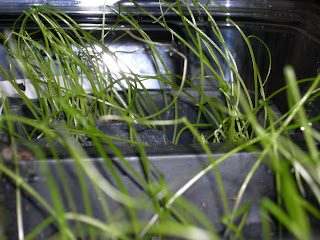
My green onions have sprouted. I'm ready for Spring!


